
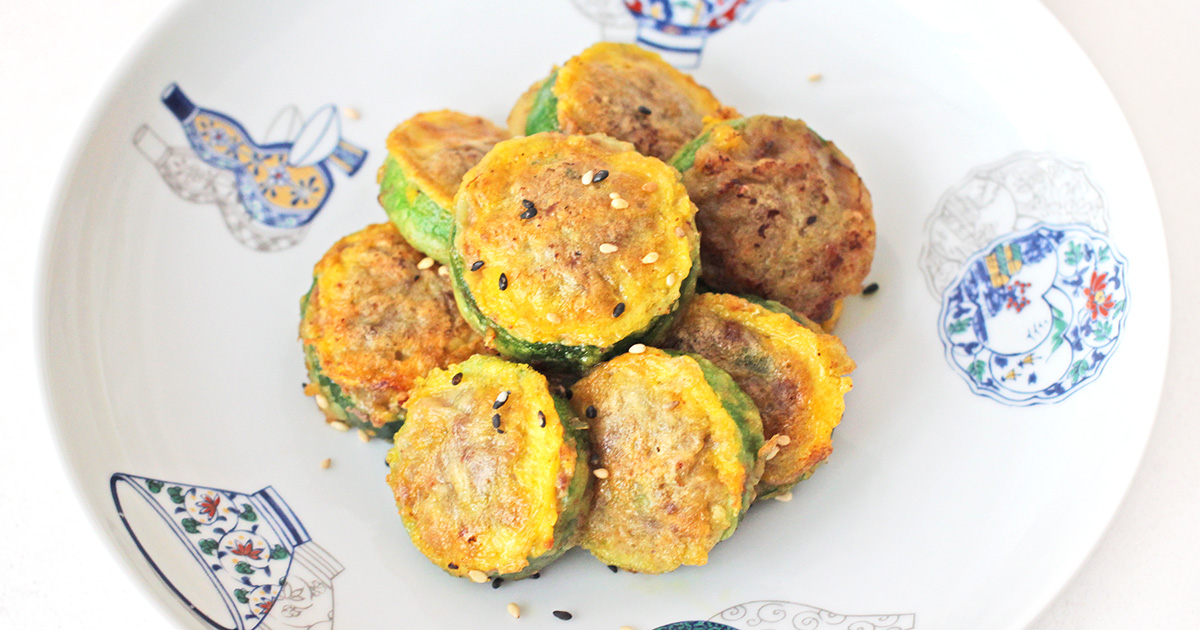

Crispy golden rings hiding juicy, perfectly seasoned beef — this is the dish that turns ordinary Tuesday nights into celebrations. No special occasion required. Just Jeong (정) and twenty minutes of your time.
Wanna bite? 🍴
There’s something magical about the rhythm of making jeon in a Korean kitchen. The gentle sizzle, the careful turning of each golden piece, the way the whole house fills with warmth and the scent of sesame oil. Korean beef-stuffed zucchini jeon carries all of that magic, but asks for nothing more than what’s already in your fridge.
Each zucchini ring is filled with the same care she put into every dish — not just food, but an expression of Jeong (정), that deep Korean concept of love made visible through action.
Now, in my Toronto kitchen, I make this when I need to feel that connection across time and distance. When I want to create holiday warmth without the pressure of perfection. Because here’s what I’ve discovered through my journey from Seoul to Toronto to here: you don’t need a special occasion to make someone feel special. You just need zucchini, good beef, and the willingness to take that extra moment to knead with intention.
Hobakjeon is Korean comfort food at its most elegant — tender zucchini rings embracing savory, impossibly juicy beef, all wrapped in a crispy golden coating. It’s what happens when technique meets heart, when my family’s wisdom meets my designer’s eye for presentation. Each bite delivers that perfect contrast: crisp exterior giving way to tender vegetable and that bouncy, umami-rich center that makes people pause mid-conversation.
The secret? It’s all in how you treat the beef. Most recipes rush through the mixing, but that kneading step — the one that feels unnecessary when you’re tired — that’s what transforms ordinary ground meat into something extraordinary.
B’s Secret
Here’s what separates restaurant-quality jeon from the homemade version that falls apart: the sticky knead. When you combine your beef mixture, don’t just stir until combined. Knead it vigorously with your hands for 2-3 minutes until it becomes pale, sticky, and cohesive — almost like a paste.
This isn’t just mixing; you’re developing the myosin proteins that create a network capable of holding moisture and fat during cooking. In professional kitchens, we call this “developing the bind.” Your grandmother called it “putting love into the meat.” Both are right.
You’ll know you’ve kneaded enough when the mixture sticks to the sides of the bowl and feels bouncy when you press it. This is what creates that signature Korean jeon texture — juicy, tender, never dry or crumbly. It’s the difference between good and unforgettable, between a recipe and a technique that showcases real skill.
This Did It!
Technique Tip:
- The salting ritual: Salt your zucchini rings and let them rest for 10-15 minutes. This draws out excess moisture that would otherwise make your coating soggy. Pat them bone-dry before coating — any remaining water is the enemy of crispness.
- Temperature control is everything: Cook over medium-low heat. High heat burns the egg coating before the beef cooks through. You want that gentle, confident sizzle that sounds like patience becoming flavor.
- The flour-egg sequence: Always flour first, then egg. The flour creates a dry surface that the egg can grip. Skip this step and watch your beautiful coating slide right off.
- Visual cues for doneness: Look for golden-brown edges and a center that feels firm when gently pressed. The beef should feel springy, not squishy.
Ingredient Swaps
- Ground beef alternatives: A 50/50 mix of beef and pork creates even more juiciness. Ground turkey works but add 1 tsp sesame oil to compensate for lower fat content.
- Zucchini options: Korean zucchini (애호박) is ideal, but regular green zucchini works beautifully. Choose medium-sized ones — they’re easier to handle and less watery than large specimens.
- Starch substitutes: No potato starch? Cornstarch works perfectly. In a pinch, you can omit it entirely if your kneading game is strong.
- Gluten-free version: Substitute tamari for soy sauce and use rice flour for dusting.
Mistakes to Avoid
- Rushing the knead: Under-developed meat mixture = dry, crumbly filling that doesn’t hold together. Your hands should be slightly tired when you’re done.
- Overstuffing the rings: Keep the beef flush with the zucchini surface. Overstuffed jeon falls apart during flipping and cooks unevenly.
- Wet zucchini: Any moisture left on the zucchini after salting will prevent proper browning and make the coating slip off.
- Crowding the pan: Give each piece space to breathe. Crowded pans drop temperature and create steamed, pale jeon instead of crispy golden ones.
Storage & Reheating
- Refrigerator: Store cooled jeon in airtight containers for up to 3 days, with parchment between layers.
- Freezer: Freeze cooked jeon for up to 1 month. For best results, freeze uncooked (after coating) and fry directly from frozen, adding 2-3 minutes to cooking time.
- Reheating: Pan-fry over medium heat for 2-3 minutes per side to restore crispness. Avoid microwaving — it turns the coating soggy.
Flavor Boosters
- Sesame finish: Sprinkle toasted sesame seeds on hot jeon immediately after cooking — they’ll stick to the surface and add gorgeous nutty fragrance.
- Aromatic egg wash: Add a few drops of sesame oil to your beaten eggs for extra depth.
- Ginger warmth: Add ½ tsp grated fresh ginger to the beef mixture for subtle heat that complements the savory flavors.
FAQ
Q: What makes this different from regular zucchini fritters? The technique and intention. This is traditional Korean hobakjeon — zucchini rings specifically stuffed with well-developed meat filling, not just mixed vegetables. The kneading process creates a bouncy, juicy texture you won’t get from simply mixing ingredients. It’s the difference between a fritter and a carefully crafted dish that showcases both technique and cultural tradition.
Q: Can I make these ahead for entertaining? Absolutely! Stuff the rings up to 4 hours ahead and refrigerate covered. For maximum convenience, coat them and freeze on a baking sheet, then transfer to freezer bags (keeps 1 month). Fry directly from frozen, adding 2-3 minutes to cooking time. This is exactly how Korean families prep for holidays.
Q: Why is my filling dry and crumbly? You didn’t knead long enough. The meat mixture should become sticky and paste-like, almost like a mousse. This protein development is what traps moisture during cooking. Also check that you’re not overcooking — medium-low heat is crucial for juicy results.
Q: Can I make this vegetarian? Yes! Replace beef with finely crumbled firm tofu (pressed dry) mixed with minced mushrooms. Season generously and add 1 tsp doenjang (Korean soybean paste) for umami depth. The kneading technique still applies — work the mixture until cohesive.
Q: What’s the best dipping sauce? Keep it simple: soy sauce with a drop of sesame oil and pinch of gochugaru (Korean chili flakes). The jeon is perfectly seasoned on its own, so the sauce should complement, not compete.
Q: How do I get restaurant-quality presentation? Consistency is key. Cut all rings the same thickness, stuff evenly, and maintain steady heat for uniform browning. Finish with sesame seeds while hot and serve on a clean, warm plate. The visual impact comes from precision and care, not complicated garnishes.
NUTRITION FACTS (per serving, 3 pieces)
Calories: 285 | Protein: 22g | Carbs: 16g | Fiber: 2g | Fat: 16g | Sodium: 580mg
✓ High-Protein | ✓ Vegetable-Forward | ✓ No Seed Oils | ✓ Meal-Prep Friendly | ✓ Freezer-Friendly


RELATED RECIPES | Korean Home Cook🔗
Made these golden beauties? Tag @bommgachi + #BommgachiKitchen — I love seeing your plating style!
Tell me: Who are you making this for? Someone you love, or yourself on a day that needs a little magic? Food is how we speak Jeong (정).
Made this recipe? Tag @bommgachi with #BommgachiKitchen!
Share your creations, comment below, and subscribe to my newsletter for more quick and easy recipes.
In my kitchen, every dish is an act of Jeong (정) — that deep Korean care that transforms ingredients into connection. This hobakjeon carries the warmth of Seoul holiday kitchens, the precision of my professional training, and the comfort of knowing someone took time to create something beautiful.
From my family’s hands to mine, from Seoul to Toronto — each golden ring holds that journey, that evolution of technique and heart. I make this when I need to feel grounded, when I want to show love without words, when I remember that cooking for others is how I learned to stand strong again.
I hope it brings that same feeling to your table, whether you’re feeding yourself on a Tuesday that needs magic, or creating memories for the people who matter most.
My kitchen, my calm.

Golden Circles of Comfort: Korean Beef-Stuffed Zucchini Jeon — 20 Minutes Holiday Magic at Home
Description
Every Korean holiday, my family made hobakjeon — crispy zucchini rings hiding the most perfectly seasoned, juicy beef. The kind of dish that makes conversations stop mid-sentence. Now in my Toronto kitchen, I make this when I need that connection, that feeling of home across time and distance. Because you don't need a special occasion to make someone feel special. Just twenty minutes and a little Jeong (정).
Ingredients
For the Zucchini Rings
For the Beef Filling
For Coating & Frying
For Finishing
Instructions
For the Zucchini Rings
-
Wash zucchini and trim ends. Cut into 1cm (½-inch) thick rounds — thick enough to hold filling, thin enough to cook through evenly. Using a small spoon or melon baller, carefully hollow out the center of each round, leaving 5mm (¼-inch) walls. Save the scooped centers for soup or stir-fry.
-
Arrange zucchini rings on a tray and sprinkle both sides with salt. Let rest for 10-15 minutes while you prepare the filling. This draws out moisture that would otherwise make your jeon soggy.
For the Beef Filling
-
n a bowl, combine ground beef, minced garlic, chopped scallions, soy sauce, mirin, potato starch, salt, pepper, and sesame oil. Now comes the crucial part: knead vigorously with your hands for 2-3 minutes, always working in the same direction. You'll feel it transform from loose mixture to sticky, cohesive paste. This is what creates juicy, bouncy texture.
-
Pat zucchini rings completely dry with paper towels — any remaining moisture is the enemy of crispy coating. The rings should feel slightly flexible, not rigid.
Fill with intention
-
Press beef mixture firmly into each zucchini cavity, smoothing the surface so it's flush with the zucchini edges. Don't overstuff — you want the meat level with the vegetable, not mounded.
The coating ritual.
-
Set up your station: flour in one shallow dish, beaten eggs in another. Dredge each stuffed ring in flour first, shaking off excess, then dip in egg wash, letting excess drip away. The flour creates the foundation; the egg becomes the golden shell.
The golden transformation
-
Heat oil in a large non-stick pan over medium-low heat. Working in batches to avoid crowding, place coated rings in the pan. Cook 3-4 minutes until the bottom is golden brown and crispy. Flip carefully and cook another 3-4 minutes until the second side matches and the center feels firm when gently pressed.
The finishing touch
-
Transfer to serving plate and immediately sprinkle with toasted sesame seeds while still hot — they'll stick to the surface and add beautiful texture and aroma.
Serve warm with simple soy sauce for dipping. Watch as people reach for seconds without saying a word — that's Jeong (정) at work.
Nutrition Facts
Servings 3
- Amount Per Serving
- Calories 285kcal
- % Daily Value *
- Total Fat 16g25%
- Saturated Fat 4.5g23%
- Cholesterol 115mg39%
- Sodium 580mg25%
- Total Carbohydrate 16g6%
- Dietary Fiber 2g8%
- Sugars 3g
- Protein 22g44%
- Calcium 45 mg
- Iron 2.5 mg
- Vitamin D 10 IU
* Percent Daily Values are based on a 2,000 calorie diet. Your daily value may be higher or lower depending on your calorie needs.

![[SALMON SUSHI BAKE | The Viral Recipe with Zero-Waste Twist]
_
The whole internet is obsessed with sushi bake, but everyone’s missing the magic hiding in plain sight: the salmon skin. While others toss it, I air fry it into golden, shattering chips that turn viral comfort food into textural perfection.
_
🖤 B‘S SECRET
Stop. Throwing. Away. The. Skin.
creamy meeting crispy — is what makes people stop mid-conversation and ask for the recipe.
_
👇 YOU’LL NEED:
• 🐟 Sushi-grade salmon (SAVE that skin!)
• 🍚 Rice seasoned with miso + sesame oil
• 🧀 Cream cheese + miso + lemon magic
• 🥑 Avocado, scallions, nori for wrapping
• ✨ Air fryer for the crispy skin revolution
_
Save this before your next salmon dinner. Your guests will think you‘re a genius.
_
🎵Music by @gordoncrumb_ - Relax via @hellothematic
#sushibake #salmonsushibake #viralrecipe #crispysalmonskin #zerowastecooking salmonrecipes](https://bommgachi.com/wp-content/plugins/instagram-feed/img/placeholder.png)