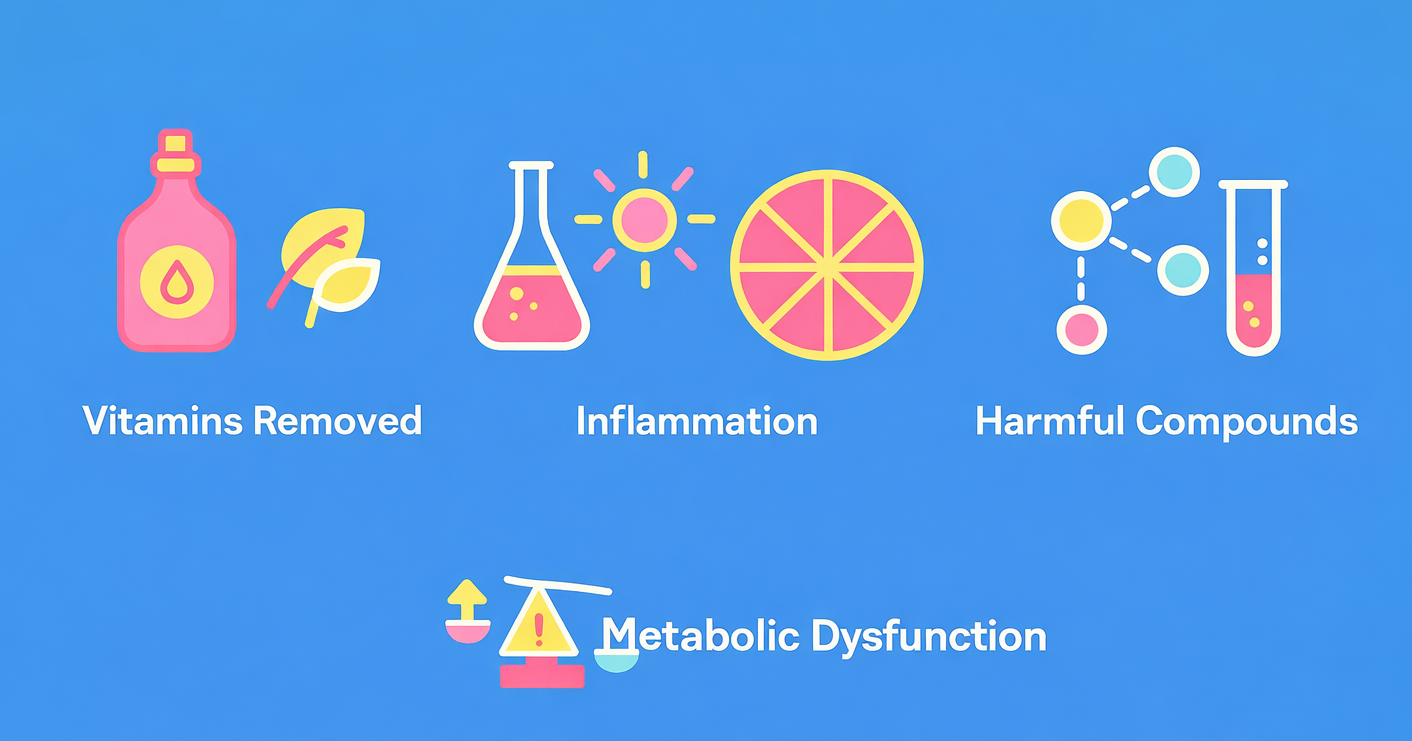
This question became louder after watching Fed A Lie.
The film raised concerns about seed oils — their industrial processing, their rise alongside modern disease, and their place in our food system.
I didn’t take it as a verdict.
I took it as a prompt.
What science says with relative clarity
Most nutritional research agrees on a few points:
Seed oils are rich in polyunsaturated fatty acids, especially omega-6.
Replacing saturated fats with these fats tends to lower LDL cholesterol.
Lower LDL cholesterol is associated with reduced cardiovascular disease risk.
This is why major health organizations still recommend unsaturated vegetable oils within general dietary patterns.
At present, there is no strong clinical evidence that seed oils are inherently toxic when consumed in typical diets.
Where the debate becomes unstable
Much of the controversy arises when seed oils are discussed without context.
They are rarely consumed alone.
They are usually embedded in ultra-processed foods —
packaged snacks, fast food, fried and reheated meals.
When people feel better after “cutting seed oils,”
they often reduce ultra-processed food at the same time.
The improvement may be real.
But the cause is often simplified.
What science does not fully answer
There are still open questions:
- the long-term effects of repeated high-heat oil use
- individual metabolic differences
- cumulative exposure within industrial food systems
Uncertainty does not equal danger.
But it does call for humility.
My takeaway
I don’t see seed oils as poison.
But I don’t treat them as neutral when consumed unconsciously, daily, through industrial food.
The question has shifted:
Not “Are seed oils bad?”
But “What kind of food system am I participating in?”
—
My Kitchen, My Calm.